


21 May Fuel Efficiency Maintenance Tips | Roberts Complete Auto Care
Fuel Efficiency Maintenance Tips That Save You Money at the Pump in Barrie
Gas prices in Ontario just crossed the $2 per litre mark again, and if the analysts are right, we haven’t seen the worst of it yet, especially when it comes to fuel efficiency in Barrie. Whether you’re commuting to work, hauling the kids around, or just trying to get through a week without doing math at the pump, you’re feeling it. Everyone is. The good news is that fuel efficiency maintenance, the regular service work that keeps your car running the way it was designed to, can make a meaningful difference in how much you’re spending, fill-up after fill-up.
A lot of the fuel your car is burning right now isn’t actually moving you anywhere. It’s being lost to friction, neglected components, and a handful of service items that quietly fall behind schedule. Here’s what actually matters.
Tire Pressure: The Quickest Fuel Efficiency Maintenance Win
Tires lose pressure naturally, roughly one PSI per month, and faster in colder weather. Driving on underinflated tires creates rolling resistance, which forces your engine to work harder and burn more fuel to cover the same distance.
According to Natural Resources Canada, for every 10 PSI a tire is underinflated, fuel consumption increases by about 2%. If all four tires are low, which is more common than most people realize, you’re losing real money every time you fill up. Tire pressure is fast and free to check, and we look at it every time your car comes in.
Wheel Alignment: A Fuel Economy Problem You Can’t Feel
When your wheels aren’t properly aligned, they’re not all pointing in the same direction. Your car is quietly fighting a tug of war against itself, and your engine is burning extra fuel to compensate for the drag. Misalignment also wears your tires unevenly, so you pay twice — at the pump and at the tire shop.
A hard pothole, a curb tap, or just regular wear over time can knock your alignment off. You might notice a slight pull to one side, or you might feel nothing at all. Annual alignment checks are worth building into your routine, especially after an Ontario winter.
Oil Changes: Essential for Fuel Efficiency Maintenance
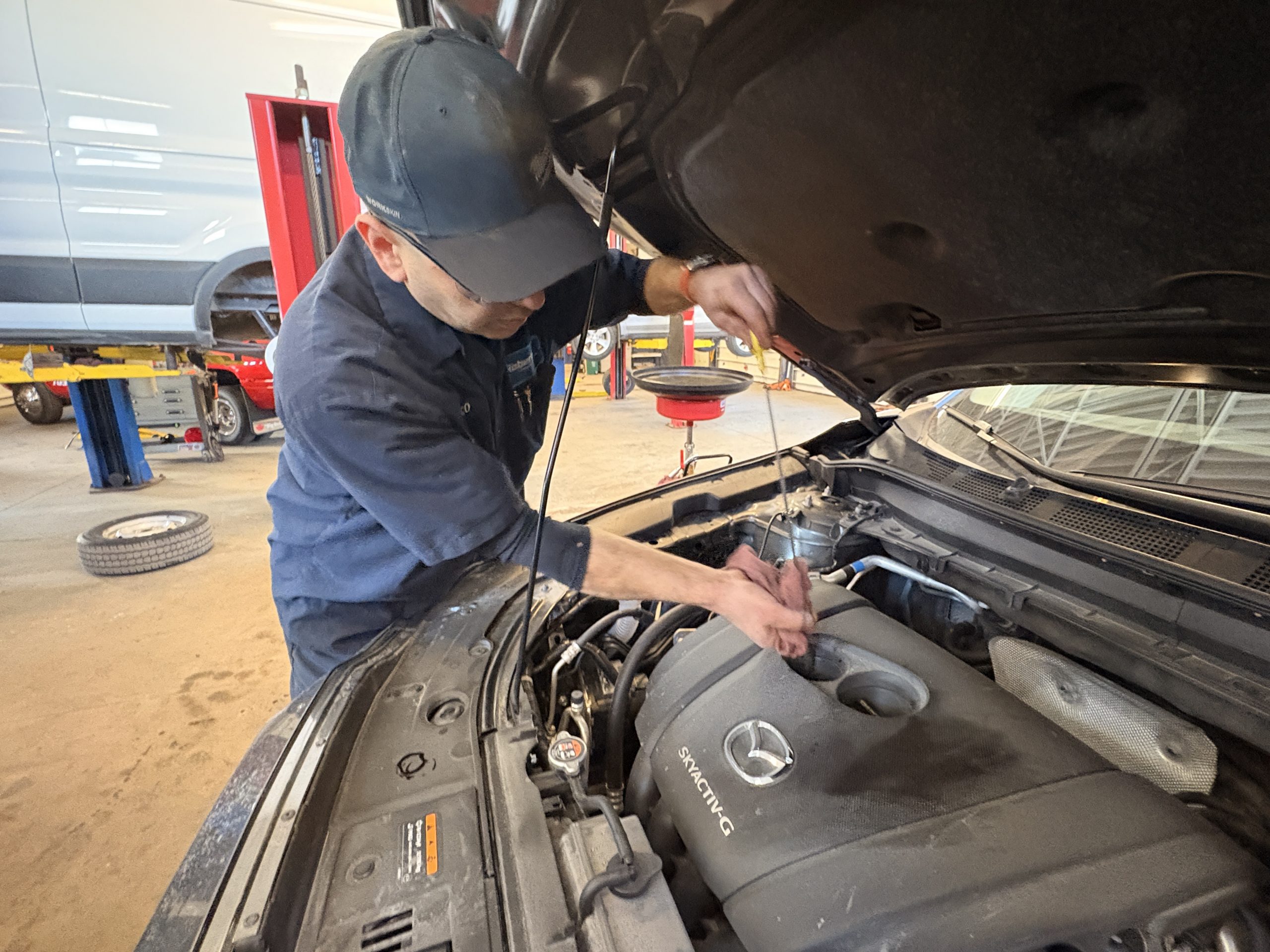
Clean oil lubricates the moving parts inside your engine. When it breaks down or the wrong viscosity is used, friction increases, and friction is the enemy of fuel efficiency maintenance. Your manufacturer specifies a viscosity grade because it matters. Using the right oil, changed on schedule, is one of the simplest things you can do for both efficiency and engine life.
If you’re not sure when your last oil change was, it’s worth finding out. We offer full-service oil changes at our Barrie location and can tell you exactly what your vehicle needs.
Air Filter: Your Engine Needs to Breathe
Your engine runs on a precise mix of fuel and air. A clogged air filter restricts airflow, and when the engine can’t breathe properly, it compensates by burning more fuel. A restricted filter is the mechanical equivalent of trying to run with a cloth over your face.
Air filters are inexpensive and often overlooked. We check yours during every routine service visit and let you know when it’s time for a replacement.
Spark Plugs: How Worn Plugs Hurt Your Fuel Economy
Worn spark plugs cause incomplete combustion — some of your fuel passes through the engine without doing anything useful. The result is lower fuel economy, sluggish acceleration, and sometimes a rough idle that tells you something is off before the check engine light does.
Modern vehicles often use long-life plugs rated for 100,000 km or more, but they don’t last indefinitely. If your spark plugs are overdue, fuel economy is usually the first thing to suffer.
Fuel System Cleaning: Dirty Injectors Are Wasteful Injectors
Fuel injectors spray a precise mist of fuel into the combustion chamber. Over time, deposits change the spray pattern from a fine mist into something less efficient, and combustion suffers for it. Fuel system cleaning is one of those fuel efficiency maintenance services that tends to fly under the radar until there’s a noticeable problem — but as a preventive step, it pays for itself.
Oxygen Sensors: Your Engine’s Fuel Manager
Your vehicle’s engine management system uses sensors to decide exactly how much fuel to inject with each combustion cycle. When an oxygen sensor degrades, the engine often defaults to running rich — more fuel than it actually needs, every single time. You might not feel the difference, but your fuel consumption goes up and your wallet feels it eventually.
A check engine light is often the first sign. If yours is on, bringing your vehicle in for a diagnostic is always the right move. It’s not always something expensive, but it’s always something.
Thermostats: Your Engine Should Reach Operating Temperature
This one surprises people. Your engine runs most efficiently at its optimal operating temperature. When a thermostat fails in the open position, coolant flows constantly and the engine never fully warms up. A cold-running engine runs a richer fuel mixture every single drive. If your temperature gauge takes unusually long to climb, or your cabin heat is weak in winter, a faulty thermostat could be why.
Brakes and Wheel Bearings: Drag You Never Notice
Sticking brake calipers and worn wheel bearings both create mechanical drag on your wheels. Your engine works harder to overcome that resistance without you ever knowing it’s happening. If your car pulls to one side, or one wheel area feels hotter than the others after a drive, that’s worth having looked at. It affects both fuel economy and brake life.
Transmission Service: Smooth Shifts and Better Fuel Efficiency
Transmission fluid breaks down over time, just like engine oil. When it does, shifting becomes less precise and the transmission loses efficiency in transferring power from engine to wheels. A transmission service at the manufacturer’s recommended interval keeps power delivery clean and your fuel economy where it should be.
The Bottom Line
None of these are dramatic repairs. They’re straightforward service items that belong on a regular maintenance schedule. Individually, each one makes a modest difference. Together, a properly maintained vehicle can use meaningfully less fuel than a neglected one.
At Roberts Complete Auto Care, we’ve been helping Barrie drivers get the most out of their vehicles for decades. If you’re not sure where your car stands, or if it’s been telling you something you haven’t had time to address, now is a great time to bring it in. We’ll give you a straight answer about what it actually needs — no pressure, no surprises.
Call 705-719-1207 to book your appointment at Roberts Complete Auto Care today. Your car works hard. A little fuel efficiency maintenance goes a long way toward making sure it isn’t burning your money on the way to the pump.
No Comments